


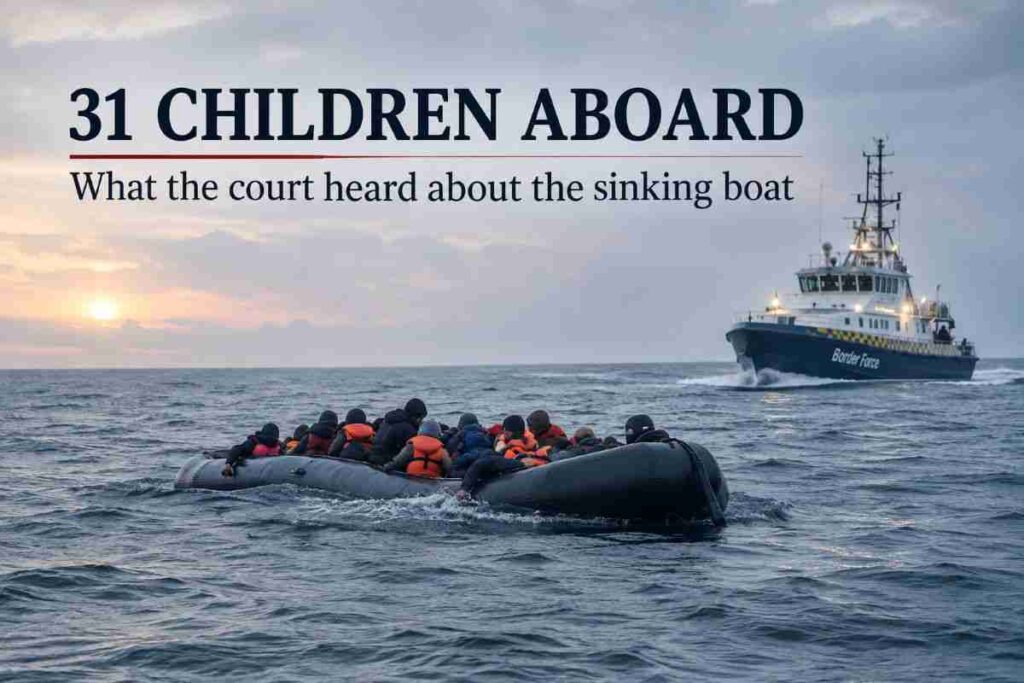
A Channel crossing carrying 165 people, including 31 children, has come under scrutiny after a teenager who piloted the vessel was sentenced at Canterbury Crown Court. The boat was reportedly deflating, had an engine failure and was taking on water before Border Force vessels intervened. (Reuters)
The case raises a wider question that often gets lost in the headlines: what actually happens when people reach the UK after a small-boat crossing, and does arriving by this route automatically mean someone can stay?
Contents
What actually happened on the Channel boat?
The incident took place on 23 July 2026. Chan Mathok Atak, a 19-year-old from South Sudan, admitted endangering others after piloting the overcrowded dinghy for part of its journey from the French coast towards Britain.
The vessel carried 165 people, including 31 children aged between 14 and 17. It was around 14 metres long and had two outboard engines, but one was not working. The court also heard that parts of the inflatable structure were deflating, while a passenger was seen repeatedly trying to pump air back into it. (ITVX)
The boat had reportedly been at sea for almost 24 hours and lacked basic navigation and emergency equipment. Border Force eventually intercepted it after it had reached British waters.
Atak was sentenced to two years and three months in prison after pleading guilty. The court heard there was no evidence that he had organised the crossing or profited from it, although the judge found that taking control of the vessel meant he assumed responsibility for the safety of those aboard. (Internazionale)
What does this mean for Channel crossings and asylum?
One important misconception is that everyone arriving by small boat is automatically granted asylum or allowed to remain in Britain.
That is not how the system works. Home Office statistics show that most people arriving on small boats go on to claim asylum, but an asylum claim still has to be considered through the UK immigration system. In the year ending June 2026, small-boat arrivals accounted for 33,374 detected arrivals. (GOV.UK)
The figures also show why individual incidents should not be treated as representative of every crossing. The average number of people per small boat has risen over time, reaching 65 in the year ending June 2026, according to the latest Home Office statistics. (GOV.UK)
The Government also distinguishes between arrivals, asylum claims and successful protection decisions. They are separate stages, rather than different names for the same outcome.
Common misconceptions about small-boat arrivals
“Everyone on a small boat is an asylum seeker.”
Not necessarily. The Home Office records people as small-boat arrivals based on how they entered the UK; an asylum claim is a separate matter. Some people may subsequently receive another immigration outcome.
“Reaching Britain means you automatically get refugee status.”
No. Refugee status is not automatically granted simply because someone arrives and claims asylum. Applications are assessed under the relevant immigration and protection rules.
“All small boats are the same.”
They are not. The size, passenger numbers, equipment and condition of vessels vary. This particular boat was exceptionally crowded and had significant safety problems, according to evidence presented in court. (ITVX)
What happens next?
For people arriving by small boat, the next steps depend on their individual circumstances. Those who claim asylum enter the UK asylum process, while immigration enforcement and returns can apply where a person has no legal right to remain.
The latest Home Office figures record 9,694 returns of people who arrived by small boat between 2018 and the year ending June 2026. The department says more than half of small-boat asylum applications since 2018 had been refused or withdrawn, although individual cases can take time to resolve. (GOV.UK)
For readers trying to understand the wider situation, the safest approach is to use the latest Home Office statistics rather than social-media posts or individual headlines. The Government’s small-boat figures are provisional when published weekly and can subsequently change. (GOV.UK)
The key takeaway
The Canterbury case was about endangering people on a particularly dangerous Channel crossing, not a court ruling that every person who crosses the Channel by small boat has committed the same offence.
The wider immigration question is more complicated. A person’s route into the UK, asylum claim, immigration status and eventual outcome are separate issues, and current figures should be checked against the latest official statistics before concluding.