

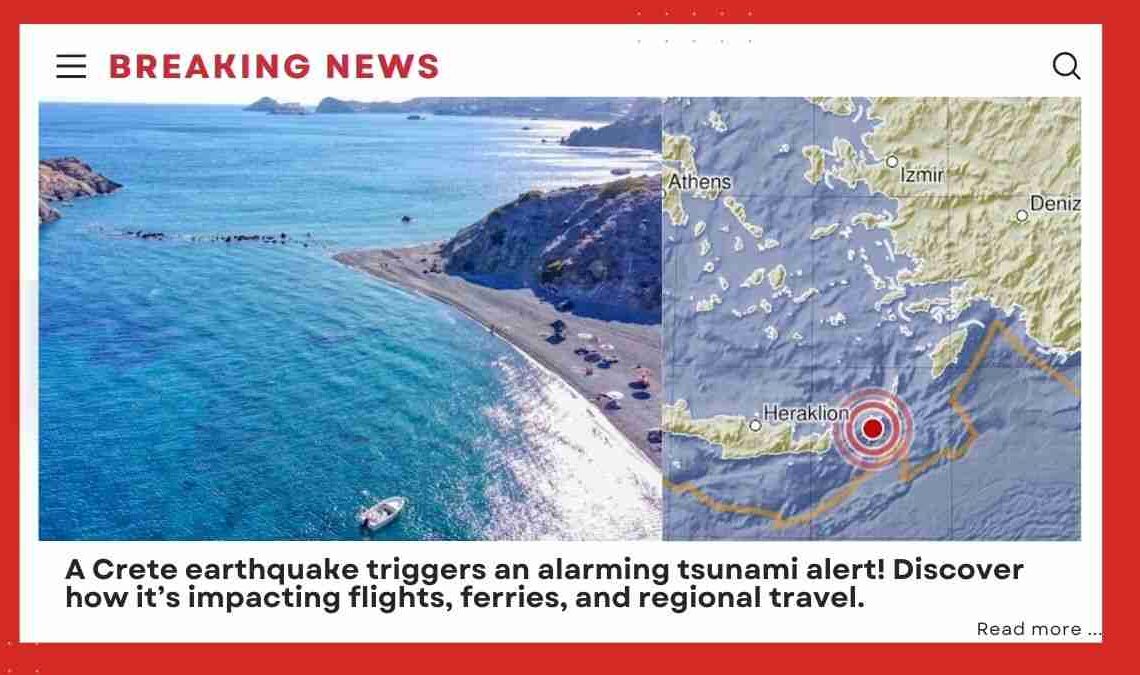
A powerful 6.3 magnitude earthquake took place in the Greek island of Crete, prompting widespread warning across the region. It causes many buildings to shake. Authorities have issued an emergency tsunami alert through the country’s 112 emergency warning system. The authority asked the visitors to move away from the coastal regions as quickly as possible.
The earthquake originated deep beneath the surface at eighty-three kilometres, however, its shakings were felt far beyond the country. Egypt’s northern coastal cities have also reported that they felt a 6.4 magnitude offshore quake.
No potential damage has been reported in either country, however, the quake has triggered heightened travel warnings.
The GFZ (German Research Centre for Geoscience) reported the earthquake, and they said it was of 6.3 magnitude. The shaking was felt as far away as Southwestern Turkey and Israel.
Greece is located on several fault lines, and it is periodically hit by earthquakes. The country experienced over 18,400 quakes between January 26 and February 13. Most of the quakes were of low magnitude, as recorded.
Greece’s Ministry of Climate Crisis and Civil Protection posted on social media that there is a tsunami risk to parts of the country’s coasts. The quake happened at 1:51 am on Wednesday. The authority has issued the tsunami warning this morning.
The Greek Island of Crete and its surrounding regions are very prone to earthquakes. Previously, in October 2021, a 6.3 magnitude quake killed one person and injured at least dozens.
Tom O Neill, 26, from London, was present in Crete for a holiday with his family. Neill said that they had to cancel their trip along the coastal regions because of the earthquake. Describing the quake, he said that he woke up and felt weird. Then, he realised that his bed was shaking, and it wasn’t just him. He also added that the incident has become more aggressive, with things starting to fall off the shelf of his hotel room. He said that the quake lasted for a minute.
A travel advisory for holiday planners has not been issued yet, meaning it would remain safe to travel in Greece and its surroundings. However, the travellers who intend to visit the east coast of Crete can check for updates from Greek authorities regarding the situation.
Greece earthquake details from GFZ show that the epicentre of the earthquake was near the Greek Islands of Kasos and Karpathos, in the Aegean Sea. As Greece lies at the line between the African and Eurasian tectonic plates, it is common to experience shaking activity very often.