
Sally Rooney’s novels are at the centre of a legal dispute that could have consequences for bookshops, publishers and readers across the UK. The prospect of her books disappearing from shelves raises an obvious question: can a court ruling really affect which authors British readers are able to buy?
The answer depends on the precise legal issue before the Supreme Court, the organisations involved and the scope of any ruling. It is important to distinguish a potential restriction on particular sales or distribution arrangements from a blanket ban on an author’s work.
What’s actually true — and why Faber is stopping UK sales
The immediate development is not a court order banning Rooney’s novels. Her publisher, Faber & Faber, has decided to stop supplying her books in the UK because of the legal risks surrounding payments to the author.
The dispute stems from Rooney’s public support for Palestine Action, a direct-action protest group proscribed as a terrorist organisation under UK law in July 2025. Rooney previously said she intended to donate earnings from her books and television adaptations to the group.
Faber says current legislation means it cannot pass UK earnings on to Rooney. The publisher has therefore agreed with the author to stop supplying her work in Britain, while continuing to publish and sell her books in other territories. The Guardian has reported on the publisher’s decision and its legal background.” />
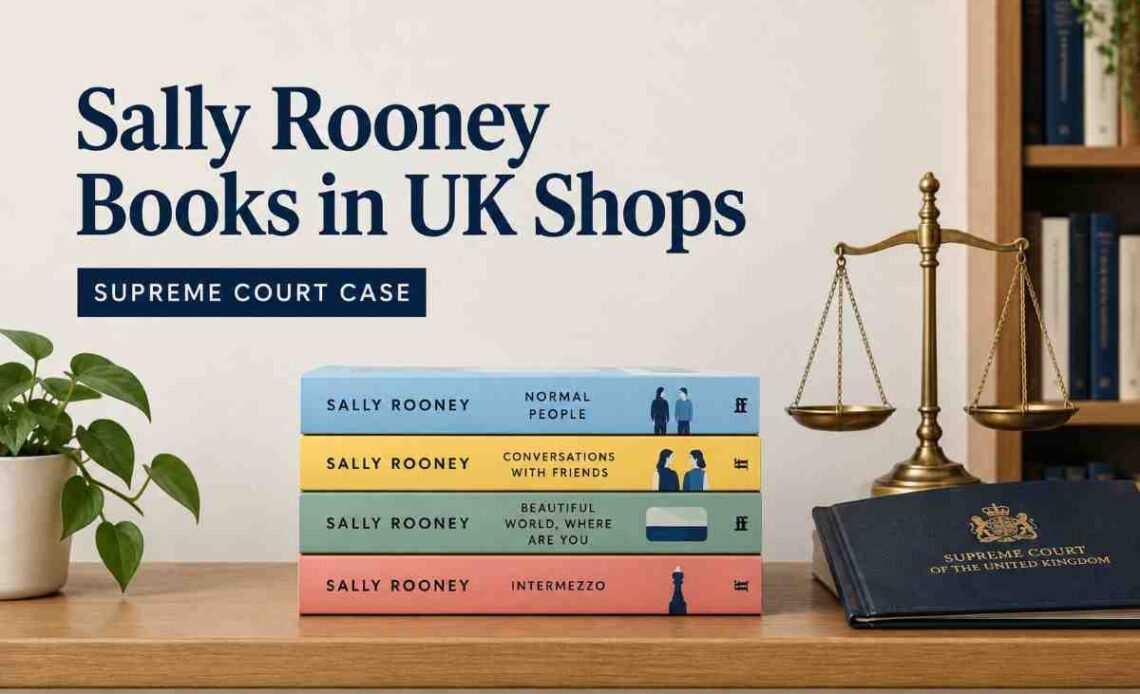
Her best-known works include Normal People, Conversations with Friends, Beautiful World, Where Are You? and Intermezzo.
What will the Supreme Court decide?
The wider legal battle concerns the government’s decision to ban Palestine Action under counter-terrorism legislation.
In February 2026, the High Court ruled that the proscription was unlawful and disproportionate. However, the ban remained in force while the government pursued an appeal. The Court of Appeal subsequently overturned the High Court ruling, leaving the dispute to proceed towards the Supreme Court. Read the background to the earlier High Court decision.
The Supreme Court’s task is to consider the legality of the proscription, rather than decide whether Rooney’s novels should be sold in bookshops.
Its eventual judgment could have wider implications for freedom of expression, protest rights and how counter-terrorism laws apply to people who express support for a prohibited organisation.
If the ban is overturned, the legal position could change significantly. However, that would not automatically settle every question about royalties, publishing contracts or the timing of a return to UK distribution.
Does this mean readers can no longer buy Sally Rooney’s books?
Not necessarily. Faber’s decision to stop supplying new stock does not mean every copy has disappeared overnight.
Books already held by retailers or other sellers may remain available while existing stock lasts. Availability will vary by title and shop, and future supply will depend on how the situation develops.
Readers should also distinguish between a publisher withdrawing its own distribution and a legal prohibition on possessing or reading a book. The announcement concerns the commercial supply of Rooney’s work; it is not a general ban on reading her novels.
What should readers, booksellers and publishers do next?
Readers hoping to buy a particular title can check independent bookshops, library catalogues and retailers’ existing stock. Availability may change, so confirm that a copy is actually in stock before travelling or placing an order.
Booksellers and publishers should seek appropriate legal advice before making decisions about royalties, contracts or new orders. The interaction between sanctions-style financial restrictions and counter-terrorism legislation can be complex, and the legal position should not be inferred from headlines alone.
Anyone following the case should look for updates from the UK Supreme Court, official court documents and reliable reporting that distinguishes a scheduled hearing from a final judgment.
The key takeaway
Sally Rooney’s books are being withdrawn from UK supply because her publisher believes it cannot legally pass her UK earnings on to her under the current rules. The Supreme Court case concerns the underlying ban on Palestine Action, not a direct ruling on the literary merits or availability of her novels.
The outcome could affect the wider legal debate around protest, expression and publishing, but readers should not assume either that every copy has vanished or that a future judgment will immediately restore normal distribution.