

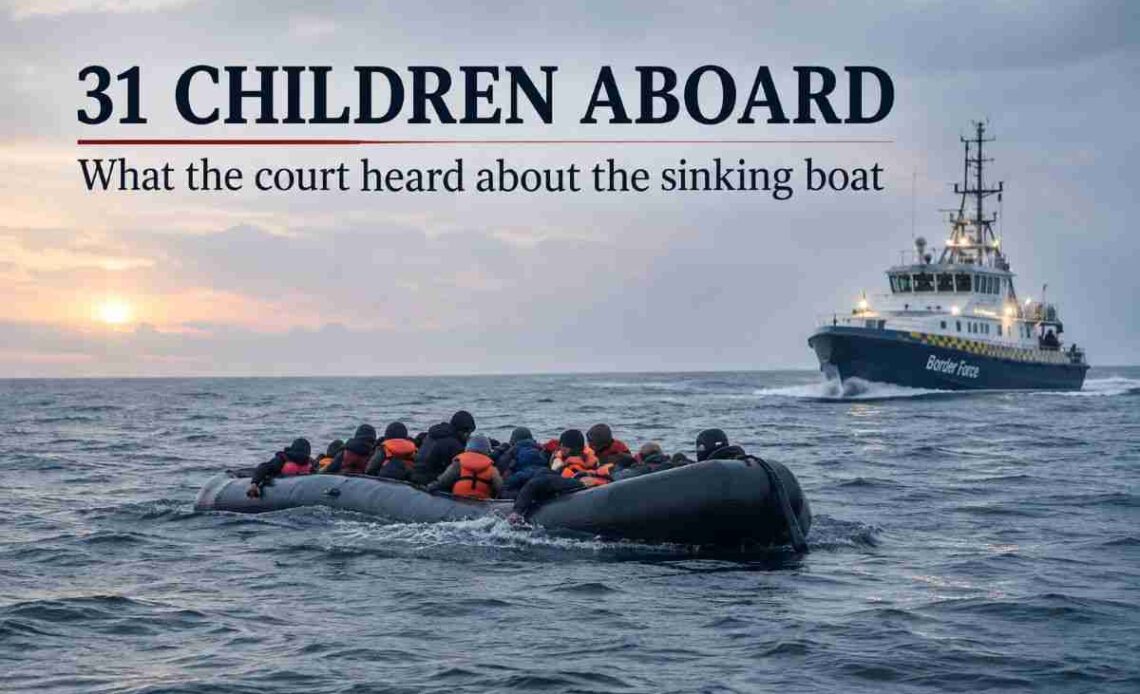
Sinking Boat With 31 Children
News

Channel crossing with 31 children aboard: what the court heard about the sinking boat

3 Mins read

A Channel crossing carrying 165 people, including 31 children, has come under scrutiny after a teenager who piloted the vessel was sentenced at Canterbury Crown Court. The boat was reportedly deflating, had an engine failure and was taking on water before Border Force vessels intervened. (Reuters)

The case raises a wider question that often gets lost in the headlines: what actually happens when people reach the UK after a small-boat crossing, and does arriving by this route automatically mean someone can stay?

What actually happened on the Channel boat?

The incident took place on 23 July 2026. Chan Mathok Atak, a 19-year-old from South Sudan, admitted endangering others after piloting the overcrowded dinghy for part of its journey from the French coast towards Britain.

The vessel carried 165 people, including 31 children aged between 14 and 17. It was around 14 metres long and had two outboard engines, but one was not working. The court also heard that parts of the inflatable structure were deflating, while a passenger was seen repeatedly trying to pump air back into it. (ITVX)

The boat had reportedly been at sea for almost 24 hours and lacked basic navigation and emergency equipment. Border Force eventually intercepted it after it had reached British waters.

Atak was sentenced to two years and three months in prison after pleading guilty. The court heard there was no evidence that he had organised the crossing or profited from it, although the judge found that taking control of the vessel meant he assumed responsibility for the safety of those aboard. (Internazionale)

What does this mean for Channel crossings and asylum?

One important misconception is that everyone arriving by small boat is automatically granted asylum or allowed to remain in Britain.

That is not how the system works. Home Office statistics show that most people arriving on small boats go on to claim asylum, but an asylum claim still has to be considered through the UK immigration system. In the year ending June 2026, small-boat arrivals accounted for 33,374 detected arrivals. (GOV.UK)

The figures also show why individual incidents should not be treated as representative of every crossing. The average number of people per small boat has risen over time, reaching 65 in the year ending June 2026, according to the latest Home Office statistics. (GOV.UK)

The Government also distinguishes between arrivals, asylum claims and successful protection decisions. They are separate stages, rather than different names for the same outcome.

Common misconceptions about small-boat arrivals

“Everyone on a small boat is an asylum seeker.”
Not necessarily. The Home Office records people as small-boat arrivals based on how they entered the UK; an asylum claim is a separate matter. Some people may subsequently receive another immigration outcome.

“Reaching Britain means you automatically get refugee status.”
No. Refugee status is not automatically granted simply because someone arrives and claims asylum. Applications are assessed under the relevant immigration and protection rules.

“All small boats are the same.”
They are not. The size, passenger numbers, equipment and condition of vessels vary. This particular boat was exceptionally crowded and had significant safety problems, according to evidence presented in court. (ITVX)

What happens next?

For people arriving by small boat, the next steps depend on their individual circumstances. Those who claim asylum enter the UK asylum process, while immigration enforcement and returns can apply where a person has no legal right to remain.

The latest Home Office figures record 9,694 returns of people who arrived by small boat between 2018 and the year ending June 2026. The department says more than half of small-boat asylum applications since 2018 had been refused or withdrawn, although individual cases can take time to resolve. (GOV.UK)

For readers trying to understand the wider situation, the safest approach is to use the latest Home Office statistics rather than social-media posts or individual headlines. The Government’s small-boat figures are provisional when published weekly and can subsequently change. (GOV.UK)

The key takeaway

The Canterbury case was about endangering people on a particularly dangerous Channel crossing, not a court ruling that every person who crosses the Channel by small boat has committed the same offence.

The wider immigration question is more complicated. A person’s route into the UK, asylum claim, immigration status and eventual outcome are separate issues, and current figures should be checked against the latest official statistics before concluding.

Related posts
News

Crypto billionaire gives Reform UK record £36m: what it means for British politics

4 Mins read
A £36 million political donation from cryptocurrency billionaire Ben Delo has put Reform UK at the centre of a fresh debate over…
News

Nicolas Cage’s Spider-Noir Cancelled After One Season — What Happened to the Prime Video Marvel Show?

3 Mins read
Nicolas Cage’s unlikely return to the Spider-Man universe has come to an early end. Spider-Noir, the live-action Marvel series starring Cage as…
News

Kent-born Milo Yiannopoulos detained by US immigration and faces deportation to the UK

3 Mins read
Milo Yiannopoulos, the controversial British political commentator born in Chatham, Kent, has been detained by US immigration authorities and is facing removal…
We use cookies to personalise content and ads, to provide social media features and to analyse our traffic. We also share information about your use of our site with our social media, advertising and analytics partners. View more
Cookies settings
Accept
Decline
Privacy & Cookie policy
Privacy & Cookies policy
Cookie name Active

Who we are

Suggested text: Our website address is: https://londonluxurymag.co.uk.

Comments

Suggested text: When visitors leave comments on the site we collect the data shown in the comments form, and also the visitor’s IP address and browser user agent string to help spam detection. An anonymized string created from your email address (also called a hash) may be provided to the Gravatar service to see if you are using it. The Gravatar service privacy policy is available here: https://automattic.com/privacy/. After approval of your comment, your profile picture is visible to the public in the context of your comment.

Media

Suggested text: If you upload images to the website, you should avoid uploading images with embedded location data (EXIF GPS) included. Visitors to the website can download and extract any location data from images on the website.

Cookies

Suggested text: If you leave a comment on our site you may opt-in to saving your name, email address and website in cookies. These are for your convenience so that you do not have to fill in your details again when you leave another comment. These cookies will last for one year. If you visit our login page, we will set a temporary cookie to determine if your browser accepts cookies. This cookie contains no personal data and is discarded when you close your browser. When you log in, we will also set up several cookies to save your login information and your screen display choices. Login cookies last for two days, and screen options cookies last for a year. If you select "Remember Me", your login will persist for two weeks. If you log out of your account, the login cookies will be removed. If you edit or publish an article, an additional cookie will be saved in your browser. This cookie includes no personal data and simply indicates the post ID of the article you just edited. It expires after 1 day.

Embedded content from other websites

Suggested text: Articles on this site may include embedded content (e.g. videos, images, articles, etc.). Embedded content from other websites behaves in the exact same way as if the visitor has visited the other website. These websites may collect data about you, use cookies, embed additional third-party tracking, and monitor your interaction with that embedded content, including tracking your interaction with the embedded content if you have an account and are logged in to that website.

Who we share your data with

Suggested text: If you request a password reset, your IP address will be included in the reset email.

How long we retain your data

Suggested text: If you leave a comment, the comment and its metadata are retained indefinitely. This is so we can recognize and approve any follow-up comments automatically instead of holding them in a moderation queue. For users that register on our website (if any), we also store the personal information they provide in their user profile. All users can see, edit, or delete their personal information at any time (except they cannot change their username). Website administrators can also see and edit that information.

What rights you have over your data

Suggested text: If you have an account on this site, or have left comments, you can request to receive an exported file of the personal data we hold about you, including any data you have provided to us. You can also request that we erase any personal data we hold about you. This does not include any data we are obliged to keep for administrative, legal, or security purposes.

Where your data is sent

Suggested text: Visitor comments may be checked through an automated spam detection service.
Save settings
Cookies settings