

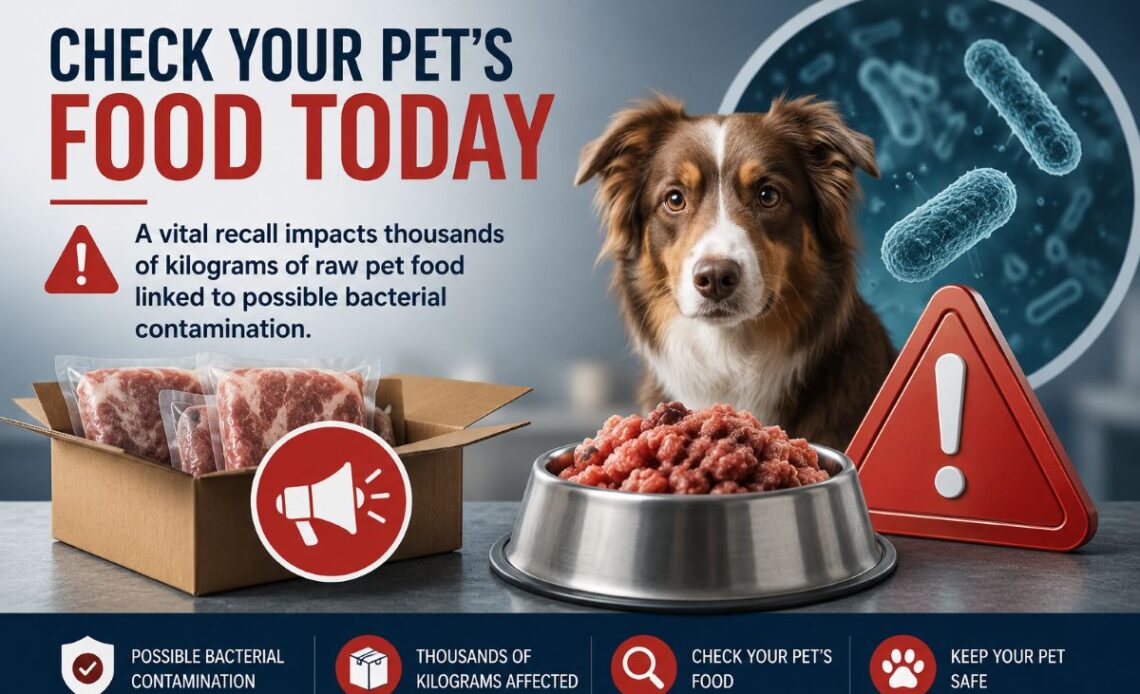
Tens of thousands of kilograms of raw frozen pet food have been voluntarily recalled across multiple American states following regulatory warnings over potentially fatal bacterial contamination and subsequent reports of animal illnesses.
The widespread safety action primarily involves an expanded recall by Raaw Energy, alongside a separate recall by Albright’s Raw Pet Food, after government testing exposed the presence of dangerous pathogens, including Listeria monocytogenes and Salmonella. Production has been halted at affected manufacturing sites as federal and state agencies escalate their market interventions.
The United States Food and Drug Administration (FDA) initially issued a public health warning regarding Raaw Energy products earlier this year after agriculture officials in Connecticut and New Jersey discovered contamination during a routine investigation into a sick dog. Despite initial regulatory pushback, the manufacturer expanded its voluntary recall to encompass more than 180 distinct lots of frozen dog food. The affected merchandise was distributed across nine states, including New York, Pennsylvania, Massachusetts, and Maryland, where it was sold online for local collection.
Concurrently, Indiana-based Albright’s Raw Pet Food initiated a separate voluntary recall of specific raw chicken recipes packaged in half-kilogram bricks. According to official FDA notifications, a routine screening batch tested positive for Salmonella, whilst preliminary tests also detected Listeria and E. coli. The contaminated Albright’s merchandise was distributed to commercial retailers and directly to households across several states, including California and South Carolina.
Public health officials have emphasised that these pathogens present severe health risks to both animals and humans. Affected domestic pets can suffer from fever, lethargy, vomiting, and bloody diarrhoea. Crucially, the FDA noted that animals can remain asymptomatic while carrying the bacteria, shedding the pathogens through their saliva and faeces, and thereby contaminating household environments.
For humans, exposure typically occurs through contact with infected animals or contaminated surfaces, such as pet bowls and utensils. Symptoms include nausea, abdominal cramps, and fever, with severe Listeria infections potentially tracking to the nervous system to cause fatal conditions such as meningitis.
Pet owners possessing any of the recalled frozen batches are urged to cease using the products immediately. Regulations dictate that the affected food must be securely discarded in sealed containers to prevent scavenging by local wildlife, and all contact surfaces must be thoroughly sanitised.